

Amritsar Hockey Academy Reopens After 5 Years, Selects 60 Young Punjab Players
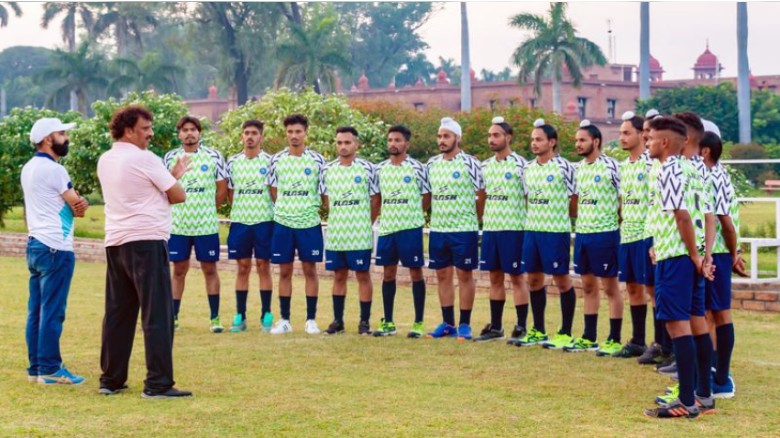
Amritsar’s Maharaja Ranjit Singh Hockey Academy has revived its residential training programme after a break of nearly five years, selecting 60 young players as it renews its focus on developing hockey talent from Punjab’s border districts.
The academy, established in 2005, had seen its residential programme disrupted following the Covid-19 pandemic.
Its revival is aimed particularly at identifying promising players from Amritsar, Tarn Taran, Gurdaspur and other parts of Punjab where hockey continues to have a strong grassroots presence.
Olympian Balwinder Singh Shammi, who has played a central role in the academy since its establishment, personally visited schools and communities to encourage young players to participate in the latest selection process.
Around 400 youngsters attend trials
The renewed recruitment drive attracted approximately 400 aspiring hockey players from across Punjab.
A three-stage selection process was then used to shortlist 60 players for the residential programme.
The selected trainees are staying at the academy’s hostel at Guru Nanak Wara near Khalsa College in Amritsar.
The academy has returned to the scouting approach it used before the pandemic, with particular emphasis on finding players from areas where access to professional training facilities may be limited.
Focus on Punjab’s border districts
The academy was established with the aim of identifying young hockey talent in Punjab’s border belt.
Amritsar, Tarn Taran and Gurdaspur have historically produced significant numbers of hockey players, and academy officials believe the region continues to have substantial untapped potential.
Shammi’s latest outreach included visits to schools in remote areas to encourage children to attend trials rather than relying only on players already involved in organised hockey.
That grassroots approach has been one of the academy’s defining features since its establishment.
Academy has produced Olympic and international players
Over the years, Maharaja Ranjit Singh Hockey Academy has trained several players who later represented India internationally.
Its prominent alumni include Ramandeep Singh, Shamsher Singh and Dilpreet Singh, all of whom went on to compete at the Olympic Games.
Shamsher Singh represented India at both the Tokyo 2020 and Paris 2024 Olympics, winning bronze medals with the national team on both occasions.
Dilpreet Singh was part of India’s bronze-medal-winning squad at the Tokyo Olympics.
Ramandeep Singh represented India at the 2016 Rio Olympics.
Another academy product, Araijeet Singh Hundal, has emerged as part of a younger generation of Indian hockey players.
Hundal was a member of India’s gold-medal-winning team at the 2024 Asian Champions Trophy and also won gold at the Junior Asia Cups in 2023 and 2024.
The academy also lists several other national and international players among its former trainees.
Free education arranged for selected players
The residential programme is intended to combine hockey development with education.
The academy has renewed its association with the Amritsar-based Spring Dale Educational Society to support the schooling of selected trainees.
Academy president Sahiljit Singh Sandhu heads the educational society.
Arrangements have also been made for players studying in Classes XI and XII to receive education at Khalsa College Senior Secondary School.
The programme is designed to ensure that young players do not have to choose between full-time hockey training and continuing their studies.
Residential programme receives sports department approval
The revived residential programme received approval from Punjab sports authorities.
According to the academy’s account, approval was secured from Punjab Director Sports Harpreet Singh Sudan and Assistant Director Sports Gurjant Singh, a former Olympian and Arjuna Award recipient.
The initiative is being operated under a “Catch Them Young” approach aimed at identifying promising athletes at an early stage and giving them structured coaching.
The 60 selected players now have residential accommodation and access to regular hockey training.
Shammi remains closely involved
Balwinder Singh Shammi continues to mentor the academy’s players and regularly visits training sessions.
The former India international competed at the 1988 Seoul Olympics and represented the country at the 1986 and 1990 Hockey World Cups.
He also represented India at the 1986 Asian Games and in Asia Cup competitions.
After his playing career, Shammi remained involved in hockey administration and player selection.
Hockey India records currently identify him as director of Maharaja Ranjit Singh Hockey Academy.
Lack of synthetic turf remains concern
Despite the revival of the academy, Shammi has raised concerns about the availability of modern hockey infrastructure in Amritsar.
One of the main issues is access to a suitable operational synthetic playing surface.
Modern international hockey is played on synthetic turf, where the speed and movement of the ball are substantially different from natural grass.
Players who train primarily on grass can therefore face difficulties adjusting to the speed, ball control and technical requirements of higher-level competition.
Shammi has argued that regular access to synthetic turf is essential if young players from Amritsar are to compete effectively at national and international level.
Renewed push to develop Punjab hockey
The reopening of the residential programme gives the academy an opportunity to rebuild the player-development network interrupted during the pandemic.
With 60 young players now selected, the focus will be on combining regular coaching, accommodation and education with opportunities to progress into state and national hockey.
The academy’s record of producing Olympic and international players demonstrates the potential of structured grassroots development in Punjab’s border districts.
Its next challenge will be ensuring that the new generation receives not only coaching and education but also regular access to the modern infrastructure required for elite hockey.


Leave A Comment