









Trump and Putin’s Nuclear Rhetoric Sparks Fears of a New Global Arms Race
Trump and Putin’s Nuclear Rhetoric Sparks Fears of a New Global Arms Race
Moscow — Growing nuclear posturing from both Washington and Moscow has reignited global concerns of a renewed arms race, following a series of provocative announcements by U.S. President Donald Trump and Russian President Vladimir Putin.
Trump on Thursday declared that the United States would resume nuclear weapons testing, citing the actions of other nations.
“Because of other countries’ testing programs, I have instructed the Department of War to start testing our nuclear weapons on an equal basis,” Trump announced on social media.
It remains unclear whether the president was referring to the testing of an actual nuclear warhead or a nuclear-capable delivery system. The statement came shortly before Trump’s scheduled meeting with Chinese President Xi Jinping in South Korea. Trump later clarified that the move was not directed at China, saying the decision “had to do with others.”
Putin’s Show of Strength
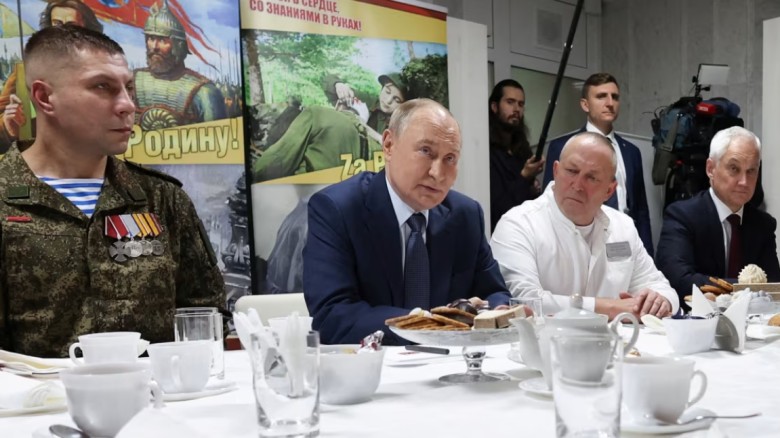
Trump’s announcement came just hours after Russian leader Vladimir Putin unveiled yet another addition to Moscow’s growing nuclear arsenal. During a visit to a Moscow military hospital, Putin told injured servicemen that Russia had successfully tested the Poseidon, an experimental nuclear-powered underwater torpedo.
“The Poseidon’s power significantly exceeds that of our most advanced intercontinental ballistic missile,” Putin said, calling the weapon “unique in the world” and “impossible to intercept.”
Putin also noted that the Sarmat intercontinental ballistic missile—nicknamed “Satan 2”—would soon be deployed, describing it as one of the world’s most powerful nuclear delivery systems.
This marked the second major weapons announcement from the Kremlin in less than a week. Days earlier, Putin claimed Russia had successfully tested the Burevestnik (“Storm Petrel”), a nuclear-powered cruise missile allegedly capable of flying for unlimited distances at subsonic speeds.
Tensions Amid Treaty Uncertainty
The timing of these developments has drawn concern, as the New START treaty, the last remaining arms control agreement between the United States and Russia, is set to expire in February 2026. The treaty currently limits the number of deployed intercontinental-range nuclear weapons each side can possess.
Military analysts have expressed skepticism about the practicality and safety of nuclear-powered weapons like the Poseidon and Burevestnik, which rely on unstable and hazardous fuel sources. Nonetheless, Russia views these tests as a strategic display of strength amid rising tensions with the West.
According to experts, the Kremlin’s nuclear rhetoric is aimed more at diplomatic leverage than direct military confrontation—intended to pressure Washington and its allies into concessions over the ongoing war in Ukraine.
Diplomatic Fallout and U.S. Response
Frustrated by Moscow’s continued aggression in Ukraine, Trump has hinted at canceling an upcoming Budapest summit with Putin and has imposed new sanctions on Russia’s two largest oil companies. In turn, Putin has continued to showcase Russia’s nuclear capabilities, overseeing what he described as “planned” nuclear triad drills involving land-, sea-, and air-launched missiles.
Speaking aboard Air Force One on Monday, Trump criticized Putin’s displays of power.
“He ought to get the war ended — a war that should have taken one week is now in its fourth year,” Trump said. “That’s what he ought to do instead of testing missiles.”
Putin, however, pressed ahead, personally appearing in military uniform to announce the Burevestnik’s success, a move that the White House dismissed as political theater.
A Dangerous New Era
Analysts warn that the escalation of nuclear rhetoric on both sides could undermine decades of arms control progress. What began as strategic posturing over Ukraine has now sparked fears of a new and unpredictable nuclear era—one defined not by deterrence, but by provocation and political brinkmanship.
As one Western diplomat put it, the world is witnessing “the hazards of mixing loose talk with nuclear weapons in an increasingly volatile world.”
If intended as a warning, Moscow’s saber-rattling may have achieved the opposite—pushing Washington toward the very nuclear revival the Kremlin hoped to deter.


Leave A Comment