









Why Narendra Modi and BJP Are Turning to Gen Z-Style Instagram Reels
Prime Minister Narendra Modi and the Bharatiya Janata Party are experimenting with a noticeably different style of political communication as they seek to strengthen their connection with India's younger voters.
Modi, whose public communication has traditionally centred on formal speeches, major events and carefully produced political messaging, has recently begun appearing in more informal Instagram videos.
The Prime Minister has posted selfie-style addresses, conversational reels and content using phrases associated with younger social-media users. In several videos, he has directly addressed young viewers as "friends".
The change is notable because Modi already has one of the world's largest social-media followings among political leaders. The new approach therefore appears to be less about establishing an online presence and more about adapting the style of that presence to platforms increasingly dominated by younger audiences.
Youth protests change the digital conversation
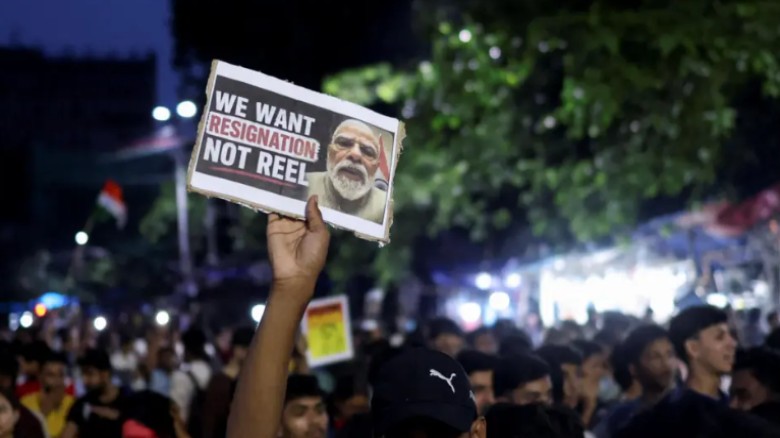
The shift has emerged following major youth-led protests in India during 2026.
The Cockroach Janta Party, or CJP, began as a satirical online movement but developed into a wider protest campaign focused initially on examination-related controversies and demands for greater accountability.
Its supporters made extensive use of Instagram reels, memes, livestreams and humour to spread their message.
The campaign eventually generated significant political pressure and was followed by the resignation of Union Education Minister Dharmendra Pradhan.
The protests also demonstrated how quickly political narratives can develop outside the traditional networks that political parties have historically used to distribute their messages.
For years, the BJP has been recognised for its highly organised digital campaigning, particularly through platforms including WhatsApp, Facebook and X.
Instagram, however, presents a different challenge.
Instead of relying primarily on networks of established supporters to circulate political messaging, Instagram's recommendation systems can push an individual video to millions of viewers depending on engagement, viewing time, shares and other signals.
That means having a large political organisation or follower base does not necessarily guarantee control over how a message is received.
Modi's videos become material for memes
Some of Modi's new videos have generated enormous audiences, but younger users have not always interpreted them in the way their creators may have intended.
One selfie-style address released during the youth protests attracted attention after Modi opened his remarks by addressing viewers as "friends".
The pause surrounding the word quickly became material for parody videos, edits and memes.
Other users criticised elements including the camera positioning, lighting and presentation.
The reaction demonstrated one of the risks political leaders face when adopting social-media formats designed around informal interaction: viewers can easily remix the original material and give it a completely different meaning.
Some young Indians have welcomed efforts by political leaders to communicate directly with their generation, while others have questioned whether adopting Gen Z language is meaningful unless politicians also respond to issues affecting younger people.
Concerns around employment, education, examination systems and opportunities for young Indians have played an important role in the recent political debate.
BJP experiments with memes and pop culture
The change has extended beyond Modi's personal Instagram account.
BJP social-media channels have increasingly experimented with internet slang, humour, memes and pop-culture references.
One party video used a gym setting to communicate a political message to younger viewers, while another used a reference to the American television series Friends.
Some of those attempts have themselves generated mockery and criticism online, highlighting the difficulty political organisations face when attempting to deliberately reproduce internet culture.
The BJP has nevertheless indicated that reaching younger voters is becoming an increasingly important part of its digital strategy.
The party recently replaced longtime social-media chief Amit Malviya with Deepak Mhaskey as part of a wider organisational reshuffle.
Mhaskey has publicly indicated that communicating information to Gen Z will form part of the party's social-media work.
Opposition leaders are targeting the same audience
The BJP is not alone in adopting a more informal online style.
Congress leader Rahul Gandhi has also increasingly used selfie videos, informal photographs and interactive social-media content.
Following the youth protests, Gandhi held an Instagram question-and-answer session in which he mixed political communication with humorous responses.
The competing strategies reflect a broader change in Indian politics, where Instagram and short-form video are becoming increasingly important channels for reaching voters who may rarely consume traditional political speeches or television news.
Instagram presents a different challenge
Political communication researchers argue that Instagram operates differently from platforms such as X or WhatsApp.
Joyojeet Pal, a University of Michigan academic who studies political use of social media, has argued that political organisations accustomed to controlling networks of supporters may find algorithm-driven platforms more unpredictable.
A relatively unknown creator can suddenly receive millions of views, while an account with an enormous following may post a video that attracts comparatively little attention.
Political messages can also be turned into jokes, memes or criticism almost immediately after publication.
That makes gaining attention considerably different from controlling the resulting political conversation.
Commentator Anurag Minus Verma has similarly argued that irony and humour are deeply embedded in Instagram culture, meaning even serious political messaging can quickly become the subject of parody.
Social-media popularity is not the same as electoral support
Analysts also caution against interpreting online reactions as direct evidence of how people will vote.
The BJP retains a large national organisation, an established voter base and extensive campaigning infrastructure across India.
A politician or political party can therefore face widespread criticism or mockery on social media while remaining electorally competitive.
For the BJP, the larger challenge is learning how to participate in a political environment in which younger users increasingly create and reshape narratives themselves rather than simply receiving messages produced by political parties.
India's young population means that this audience will become increasingly significant in future elections, including the 2029 general election.
The BJP has previously adapted successfully to major changes in political communication, from early adoption of social media to podcasts, influencer interviews and digital campaigning.
Its latest experiments with Instagram suggest the party is once again trying to adapt — this time to a generation whose political language is shaped as much by memes, reels and online humour as by traditional campaigns.


Leave A Comment