






US-China Conflict Over Taiwan Could Risk Nuclear Escalation, Study Warns
US-China Conflict Over Taiwan Could Risk Nuclear Escalation, Study Warns
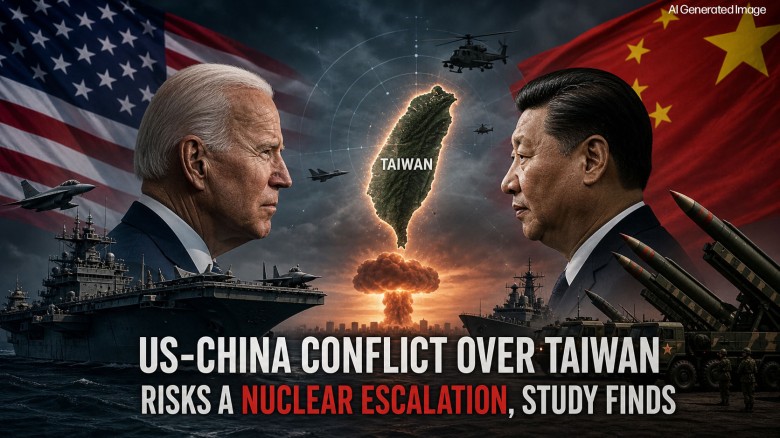
A conflict between the United States and China over Taiwan could risk escalating to the nuclear level, according to a new defence study released ahead of a major security meeting in Singapore.
The London-based International Institute for Strategic Studies said in a new regional assessment that Asia is now at the centre of growing nuclear rivalries.
The report warned that the world may be moving towards a new nuclear arms race, with the Asia-Pacific region playing a central role.
According to the study, a war over Taiwan could lead both the US and China to carry out large-scale military operations targeting each other’s command, communication and intelligence systems.
The report said there is little public evidence that the two militaries have clear “guard rails” or rules of engagement to prevent such a conflict from escalating.
The assessment warned that because Taiwan is of major strategic importance to Beijing, any conflict involving the US and China could carry the risk of nuclear escalation.
China claims Taiwan as part of its territory and has not ruled out using force to take control of the island. Taiwan’s government rejects Beijing’s sovereignty claims and says only its people can decide their future.
China’s defence ministry rejected concerns raised in the report, saying the Taiwan issue is an internal matter for China and that no outside interference would be accepted.
The report comes ahead of the Shangri-La Dialogue in Singapore, Asia’s largest annual defence meeting, which will bring together ministers, military leaders, diplomats, intelligence officials, analysts and defence industry representatives.
Taiwan, the conflict in Iran and uncertainty over US commitments in Asia are expected to be major topics at the conference.
The study also comes after a recent summit between Chinese President Xi Jinping and US President Donald Trump in Beijing, which reportedly raised concerns in Taiwan about Washington’s future commitment to helping the island defend itself.
The IISS assessment said China’s military pressure around Taiwan has increased, keeping Taipei on high alert.
Experts say one of the main concerns is the lack of direct nuclear risk-reduction talks between the US and China. During the Cold War, the US and Soviet Union held years of discussions on arms control and crisis management, but similar communication between Washington and Beijing remains limited.
IISS senior fellow Daniel Salisbury said there was no strong culture of nuclear dialogue between the two powers, making the relationship more difficult and dangerous.
While the US and Russia still hold far larger nuclear arsenals than China, analysts say Beijing is expanding and modernising its nuclear weapons faster than any other nuclear power.
A Pentagon report released in December said China could have 1,000 nuclear warheads by 2030. The Federation of American Scientists estimates that Russia has around 4,400 active nuclear warheads, the US around 3,700, and China around 620.
The report warned that without stronger communication and crisis-control mechanisms, the possibility of nuclear escalation will continue to hang over any major US-China conflict.


Leave A Comment